Open today · 06:00 – 18:30

Delhi to Taj Mahal

Delhi to Taj Mahal — Guided Day Trips & Reserved Entry

White marble at first light, the Yamuna gleaming below

245K+ travelers chose this
Free Cancellation
Right now: Moderate — summer season Arrive by 06:00 for cooler morning temperatures.
10–14 hours round trip
1 Languages
2–15 travelers
Free Cancellation
Free cancellation Instant confirmation Mobile voucher Verified partner Skip-the-line
Choose your ticket

Ticket options at a glance

Compare fares, pick the fit — all bookings are mobile-voucher and eligible for free cancellation where shown.

Private Taj Mahal & Agra Luxury Day Trip from Delhi 11 hr
Luxury / Private

Private Taj Mahal & Agra Luxury Day Trip from Delhi

4.9 (2728)
€4
  • Private experience
  • Personal attention
  • Premium amenities
  • Free cancellation
Book this ticket
Private Taj Mahal Sunrise Tour from Delhi 11 hr
Luxury / Private

Private Taj Mahal Sunrise Tour from Delhi

4.9 (467)
€2
  • Private experience
  • Personal attention
  • Premium amenities
  • Free cancellation
Book this ticket

Is it worth it?

Worth it for first-time visitors, skippable for repeats

The delhi to taj mahal journey demands roughly six hours of round-trip travel and a 1,100 INR foreign tourist entry fee — plus 200 INR more if you want mausoleum access. That is a real commitment of time and money. What you receive in return is direct, unhurried contact with one of the world's most recognised pieces of Mughal architecture: the white marble tomb, the reflecting pool, the charbagh gardens. For first-time visitors and those drawn to Indo-Islamic craftsmanship, that exchange is clearly favourable. Delhi to taj mahal tours also bundle transport and guides, softening the logistical load. Where the value erodes is for repeat visitors, budget travellers, or anyone arriving midday in August heat who will spend more time managing crowds and vendors than appreciating the monument itself.

What makes it worth it

  • Unrivalled scale and symmetry of the marble mausoleum
  • Sunrise arrival delivers cooler air and shorter ticket queues
  • 1,300 INR all-access fee reasonable for a UNESCO World Heritage Site
  • Taj Mahal tour packages absorb logistics for independent travellers
  • Agra's Mughal complex offers depth well beyond a single photo stop

Keep in mind

  • Six-hour round-trip is a full day for one monument
  • August midday heat and crowds undercut the experience sharply
  • Aggressive vendor pressure outside the gates is genuinely tiring
  • Delhi to taj mahal tickets require advance planning; walk-up queues bite

Bottom line: If you are in Delhi even briefly and have never stood before the Taj Mahal, the combined travel time and entry cost are a fair price — but first-timers only; everyone else should weigh whether a second visit adds anything new.

Head to head

Train vs. Private Car: Which Delhi to Taj Mahal Option is Best?

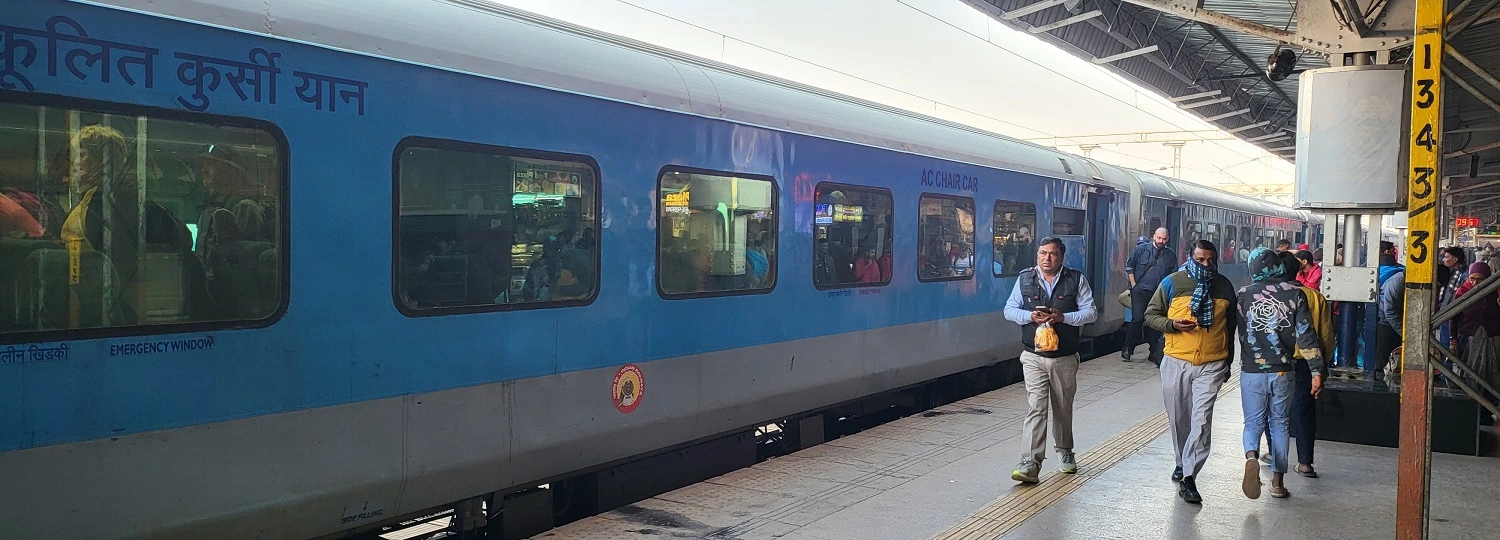
Deciding on transit is the most critical step when planning your delhi to taj mahal tour. While booking delhi to taj mahal tours by train ensures you bypass heavy highway traffic and arrive in under two hours, hiring a private vehicle via the Yamuna Expressway offers unmatched schedule control. The Gatimaan Express departs from Hazrat Nizamuddin Railway Station and arrives at Agra Cantt, providing a fast transit experience but requiring navigate-heavy railway booking systems. In contrast, a private car tour offers a convenient hotel pickup and lets you choose your departure time, though it remains subject to Delhi's unpredictable morning traffic.

Top pick
Gatimaan Express Train
Yamuna Expressway Private Car Tour
Travel Time 3 to 4 hours (door-to-door)
Departure Flexibility Fully customizable; departures available 24/7
Transit Comfort Private climate-controlled car with personal driver
Booking Complexity Low; instant booking through tour operators
Total Cost 4,500–7,500 INR per vehicle

Verdict: Buying delhi to taj mahal tickets for the Gatimaan Express is ideal for solo travelers seeking speed, whereas the Yamuna Expressway private car tour is best for families wanting door-to-door flexibility.

Featured Experiences

Popular tours & activities

Hand-picked experiences loved by thousands of travelers

Recommended Experience

Powered by GetYourGuide

Another traveler favorite

Powered by GetYourGuide
Taj Mahal & Agra Day Trip via Gatimaan Express 5 hours - 1 day Free Cancellation

Taj Mahal & Agra Day Trip via Gatimaan Express

Travel from Delhi to Agra by superfast train for a guided tour of the Taj Mahal, Agra Fort, and the Baby Taj.

4.9 (337)
FromFrom €7.29
See details
Taj Mahal & Agra Fort Group Day Trip from Delhi 12 hours Free Cancellation

Taj Mahal & Agra Fort Group Day Trip from Delhi

Experience the wonder of the Taj Mahal and historic Agra Fort on this seamless, guided group adventure from Delhi.

5 (110)
FromFrom €18.45
See details
Private Sunrise Taj Mahal & Agra Full-Day Tour 5 - 11 hours Free Cancellation

Private Sunrise Taj Mahal & Agra Full-Day Tour

Discover the Taj Mahal at dawn and explore Agra’s Mughal treasures on this private, seamless day trip from Delhi.

5 (79)
FromFrom €1.82
See details
Your journey

Step-by-step — what your day looks like

1

Morning Departure from Delhi

Board the early morning Gatimaan Express train or drive via the Yamuna Expressway to travel from Delhi to Taj Mahal locations.

2

Arrival at the West Gate

Go through security screening and present your pre-booked entry tickets to access the main complex gardens.

3

Exploring the Gardens and Mausoleum

Walk around the reflecting pools and enter the white marble mausoleum built by Shah Jahan for Mumtaz Mahal.

4

Visiting Agra Fort

Travel to the nearby red sandstone fortress to see where the emperor was imprisoned during his final years.

5

Return Journey to Delhi

Take a evening train or drive back to Delhi to complete your heritage excursion.

What you'll see

Highlights not to miss

The Main Mausoleum

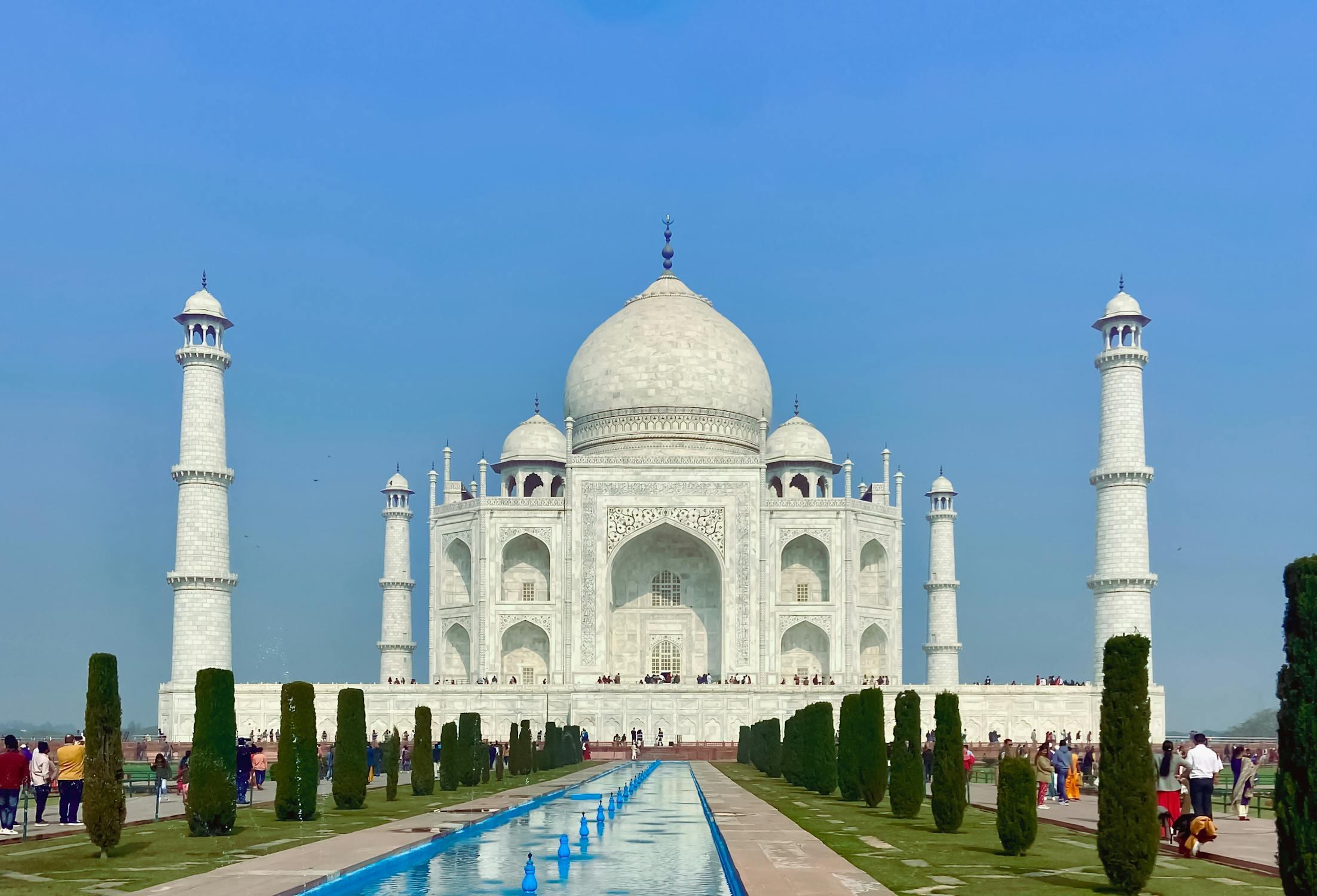
This white marble structure stands on a square plinth elevated 7 meters above the ground. It houses the cenotaphs of Mumtaz Mahal and Shah Jahan, decorated with semi-precious stones inlaid using the pietra dura technique. The dome rises to a height of 73 meters, matching the height of the Qutb Minar in Delhi.

The Great Gate

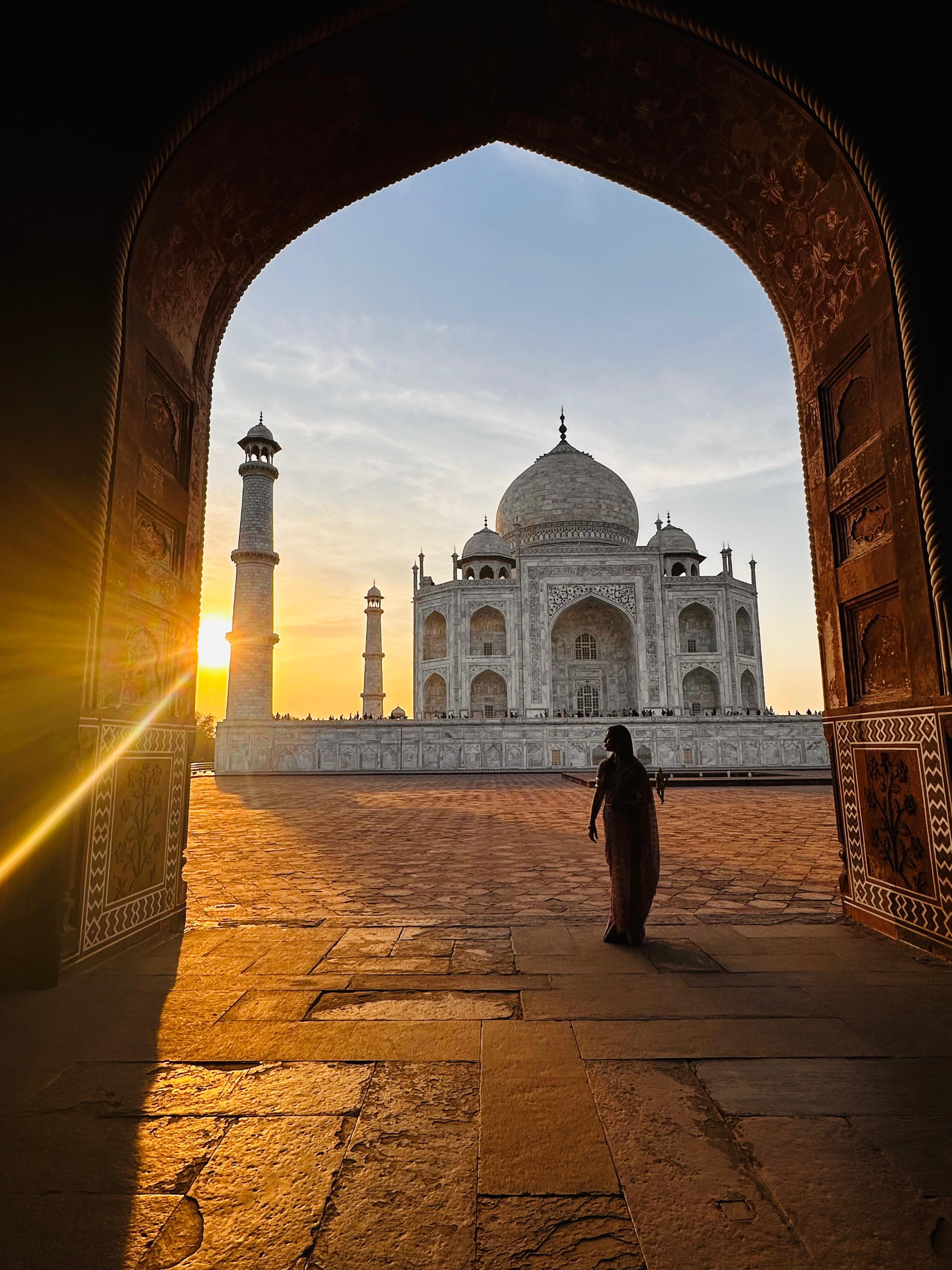
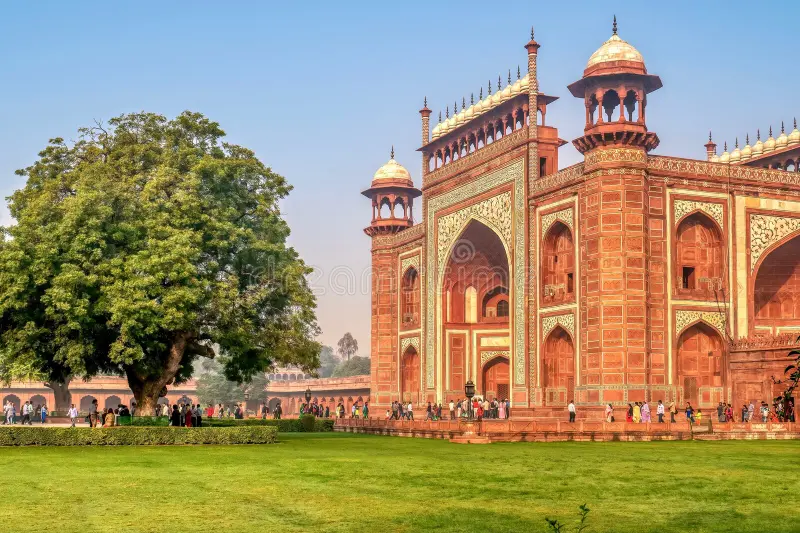
Known as Darwaza-i-rauza, this red sandstone gateway stands 30 meters tall and serves as the primary entrance to the complex. It features Arabic calligraphy of verses from the Quran inlaid in white marble along the arches. The gate is designed to create an optical illusion where the mausoleum appears to shrink as you walk closer to it.

The Mosque

Located on the western side of the main mausoleum, this red sandstone mosque faces west toward Mecca. It is mirrored on the eastern side by an identical assembly hall built to maintain the perfect architectural symmetry of the complex. The interior floor is laid with 569 prayer mats outlined in black marble.

The Assembly Hall

Also known as the Mihman Khana or Guest House, this structure stands on the eastern side of the platform. While it looks identical to the mosque, it cannot be used for prayers as it faces away from Mecca. It was primarily used to accommodate visitors and pilgrims during anniversary commemorations.

The Charbagh Gardens

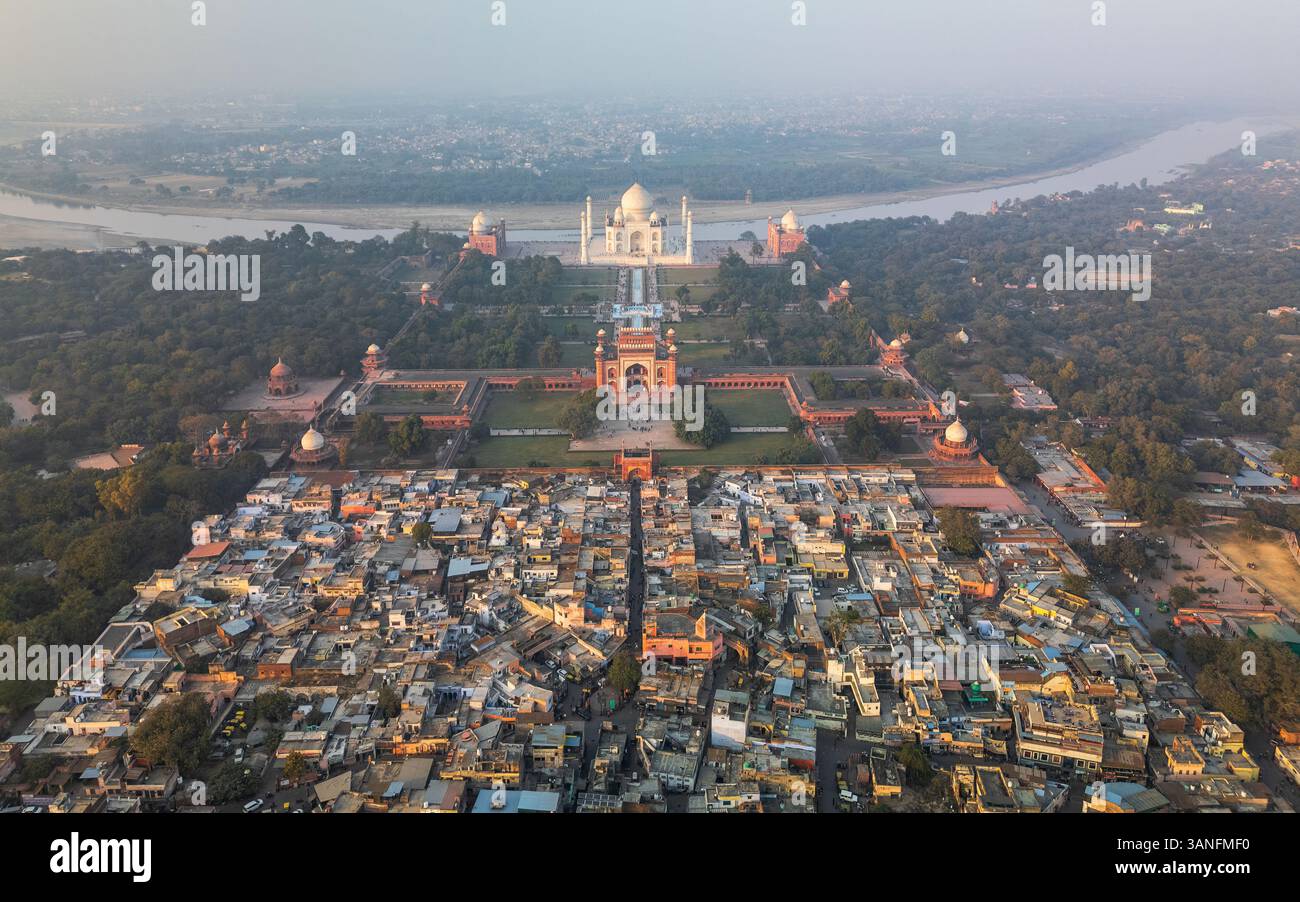
This Persian-style garden is divided by raised pathways into 16 sunken flowerbeds. A central marble reflection pool sits midway between the gate and the mausoleum, designed to project a mirror image of the monument. The layout utilizes the number four, symbolizing the four rivers of paradise described in Islamic texts.

The experience

What the visit is really like

You board your transport in Delhi before dawn, aiming to reach the East Gate at Dharmapuri, Forest Colony, Tajganj by 06:00 when the site opens. Arriving in this first window means cooler temperatures under 30°C, light that turns the makrana marble from white to rose-gold, and ticket queues that clear in minutes rather than an hour. At the entrance you present your delhi to taj mahal tickets — the standard foreign-tourist entry is 1,100 INR, with an additional 200 INR if you want access to the mausoleum itself. Pass through the Darwaza-i-Rauza and the full composition opens ahead of you: the central dome framed by four minarets, the long reflecting pool splitting the charbagh in half. Walk the eastern pool edge first — the angle catches the dome's reflection cleanest in early light. Allow 20 minutes here before moving to the marble plinth. Remove your shoes or pull on the provided shoe covers before stepping onto the platform. Inside the inner chamber, study the pietra dura inlay at close range: individual stone petals no wider than a fingernail, set without visible adhesive. You exit by the western flank, pass the red-sandstone mosque, and circle the rear terrace overlooking the Yamuna. The river view from this point is one the main approach does not reveal. By 08:30 the site begins to fill; most delhi to taj mahal tour itineraries suggest departing by 09:00 to stay ahead of midday heat and peak crowds.

Everything You Need to Know

Your complete experience guide

All the details about your upcoming adventure in one place

Delhi to Taj Mahal: Day Trip Guide

The journey from delhi to taj mahal covers roughly 200 km via the Yamuna Expressway, placing you at Agra's marble mausoleum in about 3 hours from central Delhi. Most delhi to taj mahal tours include a guide, entrance support, and stops at Agra Fort, letting you absorb two UNESCO World Heritage Sites in one day. Booking delhi to taj mahal tickets in advance ensures smooth entry to the monument, which draws visitors from across India and the world to witness the Mughal craftsmanship commissioned by Emperor Shah Jahan.

Emperor Shah Jahan employed more than 20,000 artisans and placed the first stone of the Taj Mahal in 1632, yet the mausoleum took 21 years to complete — a duration that outlasted the grief it was meant to immortalise. Commissioned in memory of his third wife Mumtaz Mahal, who died in childbirth in 1631, the structure distilled the finest traditions of Mughal, Persian, and Ottoman architecture into a single monument on the southern bank of the Yamuna River in Agra, roughly 230 kilometres south of Delhi. The Taj Mahal was designated a UNESCO World Heritage Site in 1983 and consistently ranks among the most visited monuments on the Indian subcontinent. Its significance today is not merely symbolic. The complex draws scholars of Mughal court culture, conservation architects studying makrana marble, and millions of visitors making the journey from Delhi to Taj Mahal every year. The site sits within a protected archaeological zone, and the Archaeological Survey of India manages both its structural upkeep and visitor access under a permit framework designed to limit crowding at the main mausoleum. Architecturally, the compound is more layered than a single glance suggests. The main gateway — the Darwaza-i-Rauza — frames the mausoleum through a pointed arch in a deliberate optical illusion: as you walk toward it, the white dome appears to shrink before resolving to its full height of 73 metres. Four minarets, each slightly tilted outward at 88 degrees, were engineered to fall away from the central tomb in the event of an earthquake. The interior cenotaph chamber is inlaid with pietra dura — semi-precious stones including lapis lazuli, jasper, and carnelian — set into marble panels using a technique that reached its apex under Mughal patronage. The actual graves of Shah Jahan and Mumtaz lie in a plain crypt directly below, at garden level. The surrounding charbagh — a Persian-style four-quadrant garden bisected by a long reflecting pool — aligns the mausoleum with cardinal symmetry and was designed to evoke the Quranic description of paradise. The sandstone mosque to the west and its mirror-image jawab to the east balance the composition and demonstrate that the site was conceived as an integrated urban ensemble, not a solitary tomb. For those planning Delhi to Taj Mahal tours, this full perimeter rewards a measured pace that most rushed itineraries overlook.


The Taj Mahal was not built as a wonder — it was built as a grief, and architecture turned grief into geometry.

Dress code

For visitors going from Delhi to Taj Mahal, dress code is conservative. Shoulders and knees must be covered, and shoes must be removed or covered with shoe wraps before stepping onto the marble mausoleum.

Bags & security

Security checks are thorough at all gates. Large luggage is not permitted, and you should use the cloakrooms situated outside the entrance gates.

Photography

Photography is allowed in the gardens and courtyards. Handheld cameras are permitted, but tripods, stabilizers, and drones are strictly banned.

Families & strollers

Families traveling from Delhi to Taj Mahal should note that strollers are allowed in the gardens but not on the main marble platform. Keep children close during peak times.

Accessibility

The monument grounds are flat and wheelchair-friendly. Ramps allow access to the raised platform, which helps when traveling from Delhi to Taj Mahal with mobility assistance.

Food & drink

No food items, snacks, or tobacco are allowed inside the complex. Visitors can carry a single plastic water bottle, which is provided with the foreign tourist ticket.

Not allowed

× Large bags × Backpacks × Camera tripods × Drones × Food items × Tobacco × Lighters × Sharp objects × Weapons × Chargers × Electronic cables

What to bring

✓ Valid photo identification ✓ Official entry ticket ✓ Small bottle of water ✓ Shoe covers ✓ Sunglasses ✓ Sunscreen

Opening hours

Mon 06:00 – 18:30

Quietest weekday morning

Tue 06:00 – 18:30

Moderate crowd levels

Wed 06:00 – 18:30

Moderate crowd levels

Thu 06:00 – 18:30

Moderate crowd levels

Fri Closed

Weekly closure

Sat 06:00 – 18:30

Heavy weekend crowds

Sun 06:00 – 18:30

Heavy weekend crowds

Closures & exceptions

  • ·Every Friday — Weekly closure

At a glance

Hours

Mon-Thu, Sat-Sun: 06:00–18:30 (Friday Closed)

Address

Dharmapuri, Forest Colony, Tajganj, Agra, Uttar Pradesh 282001, India

Best Arrival

06:00–08:00 — Arrive at sunrise for cooler temperatures and shorter lines.

Route

High-speed trains and expressways connect Delhi to Taj Mahal locations.

Bags

Only small bags carrying essentials are permitted inside.

Getting there

Public transport · 1.7 hours · 300 - 1500 INR

Board the Gatimaan Express from Hazrat Nizamuddin Station to Agra Cantt, which takes approximately 100 minutes. From Agra Cantt, hire an auto-rickshaw or taxi to reach the monument entrance.

Car · 3.5 hours · 1000 - 3000 INR

Drive via the 165-kilometer Yamuna Expressway directly from Delhi to Agra. Heavy toll charges apply along the route, and parking is available at designated transit points.

Taxi · 3.5 hours · 4000 - 8000 INR

Book a private chauffeur-driven cab for a round-trip day journey from your Delhi accommodation to the monument gates.

Cancellation policy

Refund policies do not apply to Delhi to Taj Mahal tickets once booked. The 1,100 INR entry fee and 200 INR mausoleum access charge are completely non-refundable.

Plan your time

How long do you need?

Recommended time

2-3 hours

Planning a same-day excursion from delhi to taj mahal requires a very early departure from the capital city, typically around three or four in the morning, to ensure you arrive at the monument gates during the optimal sunrise window when temperatures are still comfortable. Many visitors booking organized delhi to taj mahal tours choose to travel via the modern Yamuna Expressway or take the high-speed Gatimaan Express train, both of which significantly reduce travel times and get you to the site before the heavy midday crowds begin to congest the entrance gates. Once inside the historic complex, a standard visit takes about three hours, which provides ample time to stroll along the reflecting pools, admire the red sandstone gateways, and explore the interior of the main mausoleum. To maximize your limited time, it is highly recommended to purchase your delhi to taj mahal tickets online in advance so you can completely bypass the lengthy ticketing lines and proceed directly to the security checkpoints on your delhi to taj mahal tour.

Crowd levels through the day

Sunrise (06:00–08:00) Light
Morning (08:00–11:00) Moderate
Midday (11:00–15:00) Heavy
Late Afternoon (15:00–18:30) Moderate
Plan ahead

When to go — year at a glance

Weather · crowds · average price — dots go green to amber to red as each metric rises.

October to March

These cooler months bring comfortable daytime temperatures. A private Delhi to Taj Mahal tour is best planned during this period, though morning fog can sometimes affect early visibility.

April to June

Summer brings extreme heat exceeding 40C. If visiting during this time, keep outdoor activities restricted to the earliest morning hours.

July to September

The monsoon season brings rain and high humidity. While the gardens look exceptionally green, expect cloudy skies and frequent showers.

Insider tips

Helpful tips for your visit

Arrive at the ticket window early

Plan to reach the entrance gates between 06:00 and 08:00. This early window helps you avoid long queues at the security checkpoints and guarantees softer morning light.

Book tickets online in advance

Avoid the long queues at the physical counters by purchasing your entry tickets on the official government portal before departure. Make sure to choose the separate mausoleum add-on if you wish to step inside the tomb chamber.

Hire official guides only

Look for government-approved tour guides carrying valid identification cards at the entrance gates. Unlicensed guides often charge high rates.

Dine outside the complex

Because no food is allowed inside, plan your meals at the rooftop cafes in Tajganj or hotels like the Oberoi Amarvilas nearby.

Book Delhi to Taj Mahal tours in advance

Securing your transport and local guide ahead of time ensures a smooth journey and lets you focus on exploring the heritage sites without hassle.

Where to meet

Meeting points

Hazrat Nizamuddin Railway Station

Nizamuddin Railway Station, New Delhi 110013

Departure point for the morning high-speed Gatimaan Express train to Agra.

Get directions

Taj Mahal West Gate

Dharmapuri, Forest Colony, Tajganj, Agra 282001

The main assembly point for local guided excursions arriving from Delhi.

Get directions
The story

The history behind the site

The Taj Mahal was born from grief. In 1631, Mumtaz Mahal — the third and most beloved wife of Mughal Emperor Shah Jahan — died during the birth of their fourteenth child. Her death shattered the emperor, and within a year he had commissioned the greatest monument the subcontinent had ever seen. Anyone planning delhi to taj mahal tours today walks toward a structure that is, at its core, an act of mourning made permanent in white Makrana marble. Construction began in 1632 on the southern bank of the Yamuna River in Agra. At its peak, roughly 20,000 artisans and laborers worked the site simultaneously — stonecutters from Rajasthan, calligraphers from Persia, inlay specialists from Central Asia, and master masons summoned from as far as the Ottoman Empire. The chief architect is generally attributed to Ustad Ahmad Lahori, though the project drew on a council of designers. It took 22 years to complete. The mausoleum itself was finished around 1648; the surrounding mosque, guesthouse, and formal charbagh garden were completed by 1653. The project consumed an estimated 32 million rupees at contemporary value — a treasury-straining expenditure that some historians argue accelerated the Mughal Empire's later fiscal decline. Shah Jahan never lived to govern freely from his creation. In 1658 his son Aurangzeb deposed him and confined him to Agra Fort, where, according to contemporary accounts, the emperor spent his final years gazing at the Taj Mahal across the river. He died in 1666 and was interred beside Mumtaz in the crypt beneath the central dome — the only asymmetry in an otherwise rigorously symmetrical complex. The monument survived colonial neglect, looting during the 18th-century invasions of Nadir Shah and the Jat rulers of Bharatpur, and the threat of demolition during the British Raj when Lord William Bentinck reportedly considered auctioning its marble. The Archaeological Survey of India, established in 1861, began systematic restoration. Acid rain from Agra's industrial belt caused visible yellowing by the 1980s, prompting the Supreme Court of India to order factory closures in a 1996 ruling that defined a protective Taj Trapezium Zone. For every traveler booking delhi to taj mahal tickets today, that legal battle is the reason the marble remains white.

1631

Mumtaz Mahal dies in childbirth, prompting Shah Jahan to commission a memorial mausoleum on the Yamuna riverbank in Agra.

1632–1648

Construction of the main mausoleum proceeds with roughly 20,000 artisans drawn from Persia, Central Asia, and across the Mughal Empire.

1653

The full Taj Mahal complex — including the mosque, guesthouse, and charbagh garden — is declared complete.

1658

Aurangzeb deposes Shah Jahan, who is confined to Agra Fort and spends his final years viewing the monument from captivity.

18th century

Nadir Shah's 1739 invasion and subsequent Jat raids strip ornamental elements including silver door fittings and gold finials from the complex.

1861

The newly founded Archaeological Survey of India begins the first systematic documentation and conservation of the monument.

1996

India's Supreme Court orders industrial closures around Agra, establishing the Taj Trapezium Zone to halt acid-rain damage to the marble.

Photo spots

Best photo spots

Diana Bench

Best light · 06:00–08:00

Sit on this famous marble seat located along the central reflecting pool to capture a symmetrical alignment of the dome. Visitors booking delhi to taj mahal tours often queue early to secure this legendary photo option.

Taj Mahal Mosque

Best light · Before 09:00

Position yourself inside the red sandstone arches of the western assembly house to frame the white marble mausoleum in a dark, clean silhouette. Having your delhi to taj mahal tickets ready at sunrise allows you to capture this shot before crowds gather.

Mehtab Bagh

Best light · Sunset

Located across the Yamuna River, this ancient garden offers a full, unobstructed view of the monument without the interior crowds. It is a key stop on a customized delhi to taj mahal tour to watch the sunset illuminate the dome.

Dussehra Ghat

Best light · Late afternoon

Walk down to the riverbank just outside the eastern wall for an authentic water-level perspective of the monument. This is a popular spot when traveling from delhi to taj mahal, where local wooden boats occasionally drift by on the calm waters.

Gallery

Moments from the experience

Customer Reviews

What travelers say

Real experiences from real travelers

4.6
Based on undefined reviews
1 ★ 320
2 ★ 480
3 ★ 1100
4 ★ 4200
5 ★ 18400
P
Priya S.
India · 2026-07-18

Dawn light on white marble

We left Delhi at 5 a.m. and the delhi to taj mahal drive on the Yamuna Expressway took just over two hours, arriving well before the crowds gathered. The marble at sunrise shifts from pale grey to the softest gold — no photograph really captures the scale of the mausoleum when you are standing on the plinth. Book your entry permits in advance through the ASI portal and carry a printed copy.

FAQ

Frequently asked questions

Everything you need to know for your journey

Around the corner

Nearby landmarks worth a detour

Agra Fort

10 min drive

landmark

A massive 16th-century red sandstone fortress that served as the main residence of the Mughal emperors.

Mehtab Bagh

15 min drive

park

A crescent-shaped garden complex situated directly across the Yamuna River, offering symmetric views of the mausoleum's rear.

Tomb of Itimad-ud-Daulah

12 min drive

museum

Often referred to as the Baby Taj, this highly detailed tomb features delicate marble inlay work.

Agra Art Gallery

8 min drive

museum

A local gallery showcasing traditional marble inlay artifacts and regional handicrafts.

Where to stay

Where to stay nearby

The Oberoi Amarvilas

10 min walk

luxury

A luxury hotel offering views of the monument from all guest rooms.

Taj Hotel & Convention Centre

15 min walk

mid-range

A modern hotel featuring a rooftop infinity pool with views of the distant monument.

Tajganj District

5 min walk

district

The immediate neighborhood surrounding the monument, filled with budget guesthouses and local dining spots.

Ready for Adventure?

Join thousands of happy travelers who have discovered this incredible experience

Book Your Experience Now